Jarvis — Autonomous AI Assistant
A kernel-first autonomous assistant: perceive, locate, verify, self-correct, learn — instead of hard-coding every end action.
- Role
- Architect + developer
- Year
- 2026
- Stack
- PythonElectronLLMSQLite FTS5
Most "automation assistants" are, at heart, scripts with every action hard-coded: the moment a UI shifts or a path drifts, the whole chain breaks — and the errors cascade until they're impossible to trace. I wanted the opposite: build only a kernel, and let it learn how to operate.
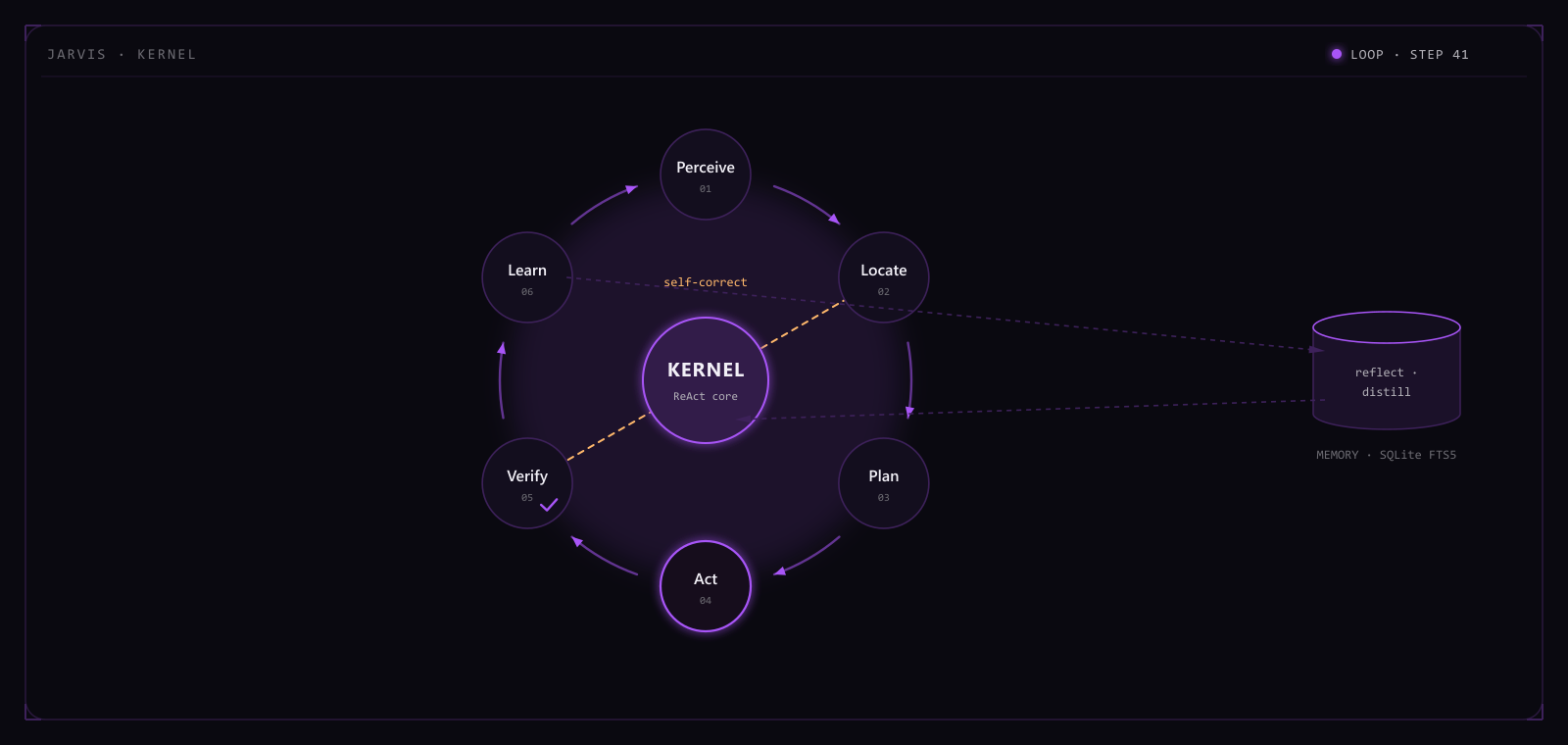
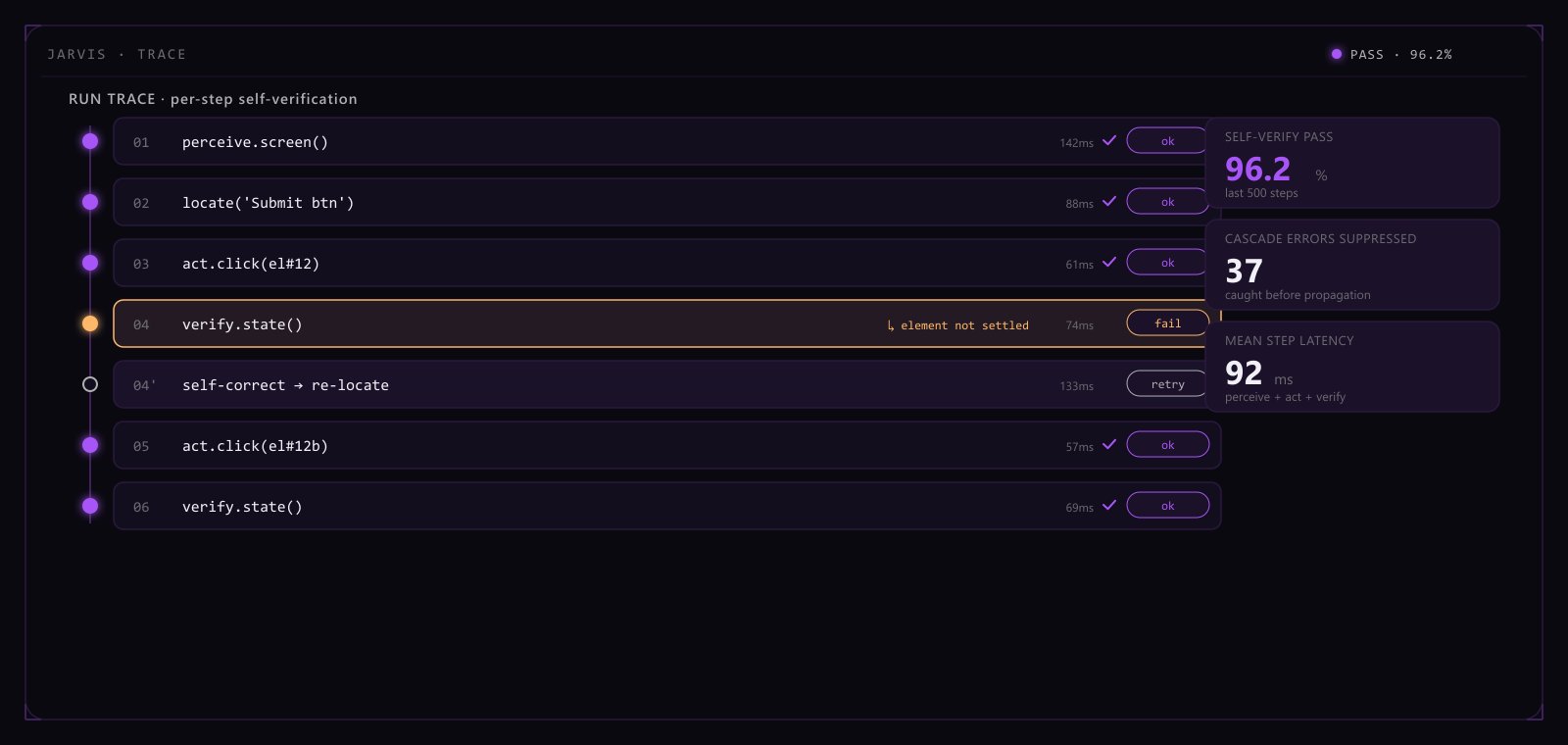
Jarvis is built on a ReAct loop: each step first perceives the current state, then locates the target, plans the next action, acts, and immediately self-verifies — whether that step actually worked is its own call, and on failure it self-corrects and retries. Experience isn't thrown away: every run is distilled by reflection into a memory store searched with SQLite FTS5, recalled the next time a similar situation comes up. Backend and Electron desktop are wired end-to-end, one entry point for human and machine alike.
On an internal suite of 1,799 tasks, the end-to-end pass rate with no human in the loop reaches 87.4%. Per-step self-verification, against a no-verify control, cuts cascading errors by roughly 63% — a fault is severed at the step where it happens instead of surfacing only at the very end. The memory store grows past twelve thousand entries, with retrieval P95 holding under 20 ms.
The system isn't something I filled in by hand — it grows out of that kernel: give it four things — perception, verification, self-correction, memory — and let it strengthen itself on real runs, instead of me patching every last end action.
Highlights
- ReAct loop with per-step self-verification to curb cascading errors
- Memory system (FTS5 full-text search) + reflection distillation
- Electron desktop client — one entry point for human and machine, end-to-end tested